 plainsight.pro
🏗️ How We're Organised
TL;DR
No hierarchy. No ivory towers. A team of experts, each with a different role, all playing for the same goal.
The Plainsight Flywheel
Think of Plainsight as a football team, not a corporate ladder. Every player has a different role: goalkeeper, midfielder, striker. But no role is more important than another. The team wins or loses together. That's exactly how we operate.
We don't have "managers" in the traditional sense. We have people who take ownership of what needs to happen, and everyone's contribution carries equal weight.
Our organisation is built around two sides of the same machine, linked together like cogs in a wheel:
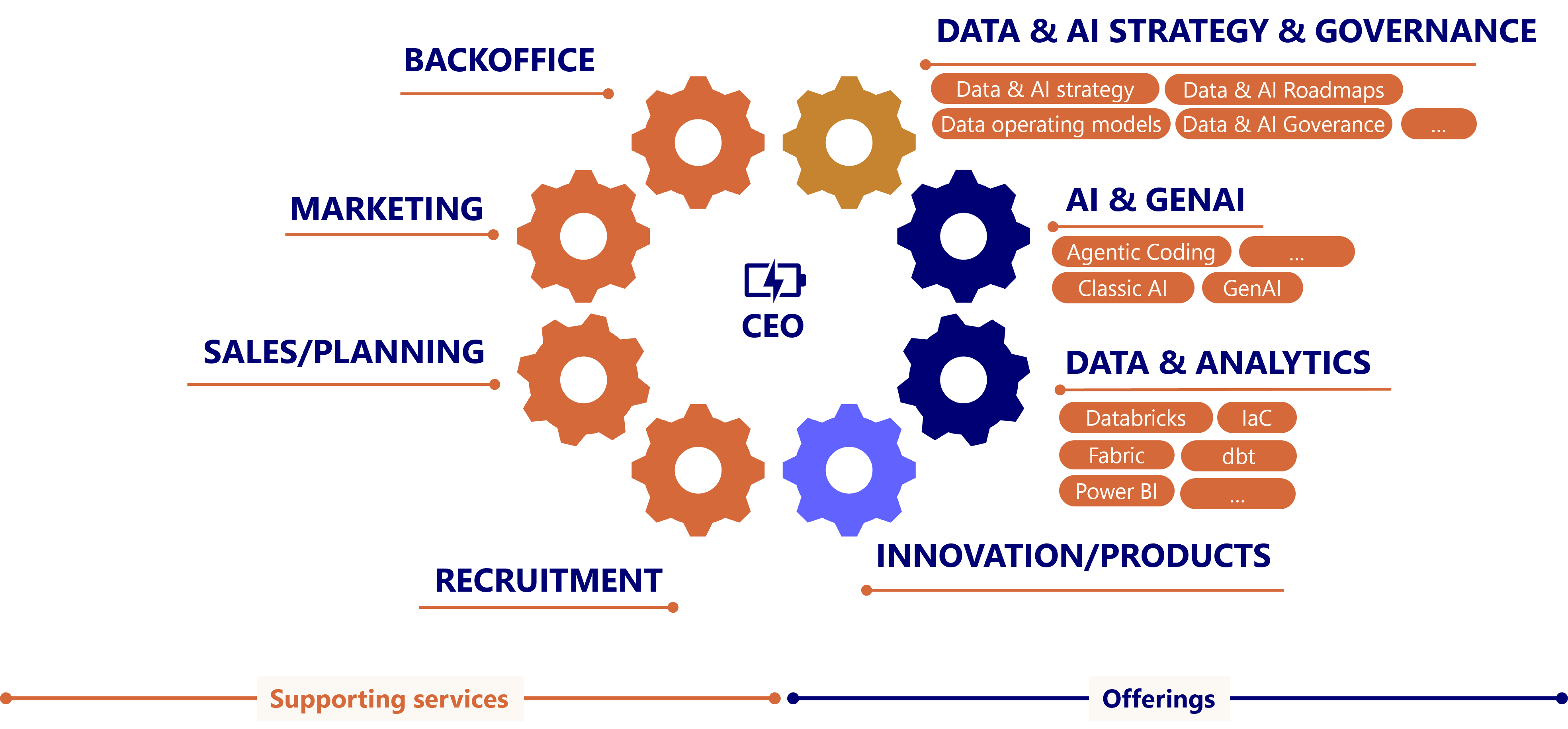
On the right sit our three offerings. This is where our experts do what they do best:
| Offering | What we do |
|---|---|
| Data/AI Strategy & Governance | Helping organisations define their data and AI roadmap and set up the right governance to make it stick. |
| AI & GenAI Implementation | Building and deploying AI and generative AI solutions that deliver real business value. |
| Data & Analytics | Engineering data platforms, analytics solutions, and everything in between. |
On the left sit the supporting services that keep the machine running: backoffice, marketing, sales, and recruitment. Without them, the offerings don't reach the people who need them.
Both sides are equally important. The cogs only turn when they work together. An expert building a customer's data platform is just as vital as the person making sure the right people find their way to Plainsight.
Offer Leads: Bridge Between Capability and Customer
Offer Leads focus on translating Plainsight's capabilities into strong offers for (potential) customers. You can also think of this as our sales-facing offer function.
Their main purpose is to:
- turn our expertise, tools, and technologies into clear offers
- show customers what Plainsight is capable of
- guide (potential) customers toward the right approach
Offer Leads are expected to have broad, high-level knowledge across what we do as Plainsight. They are not expected to know every technical detail or the nitty-gritty of each implementation.
Consultants are not split into fixed "one consultant per offer" boxes. A consultant can work on a Data Engineering trajectory today and move to another project that is closer to a different offer tomorrow.
%%{init: { "flowchart": { "useMaxWidth": true } } }%%

flowchart TB
  subgraph TOP[Offer Leads]
    direction LR
    O1[Data/AI Strategy & Governance]
    O2[AI & GenAI Implementation]
    O3[Data & Analytics]
  end

  subgraph BOTTOM[Projects & Experts]
    direction LR
    C[Shared Consultant Pool<br/>Experts assigned based on project need]
  end

  %% make the bottom banner "span" the three top blocks:
  O1 <---> C
  O2 <---> C
  O3 <---> C
How We Grow: Career Coaches
Every person at Plainsight has a career coach: someone dedicated to their personal and professional growth.
Career coaches aren't managers. They don't assign work or approve timesheets. They exist for one reason: to make sure you're evolving in the direction you want to go.
%%{init: { "flowchart": { "useMaxWidth": true } } }%%

flowchart LR
    YOU[You] -->|regular check-ins| COACH[Your Career Coach]
    COACH -->|growth direction| EVO[Evolution Process]
    COACH -->|visibility| IMPACT[Impact by Ownership]
Read more about 🎯 Evolution Process. Read more about 🚀 Impact by Ownership.
How We Learn: Knowledge Hubs
Knowledge doesn't live in silos. It circulates.
Knowledge Hubs are informal, topic-driven groups/initiative that form around subjects our experts want to go deeper on. They're not permanent departments. They come and go based on what's relevant.
| Aspect | How it works |
|---|---|
| Who starts one? | Anyone who sees the need to deepen expertise in a topic |
| Who leads? | The person who initiated it. Not appointed, self-selected |
| Who joins? | Anyone interested. No approval needed |
| How long do they last? | As long as the topic is relevant: weeks, months, or longer |
| What do they produce? | Shared knowledge: playbook pages, internal sessions, reusable assets |
This model keeps us sharp without bureaucracy. If something matters, someone will pick it up. That's how a team of experts operates.
📝 Examples of knowledge hubs we had over the past...
Databricks, dbt, LLM/RAG patterns, Fabric adoption, streaming architectures, CI/CD best practices, Azure Landing Zones, Agentic AI Architectures, Databricks AI (LLMOps), Vibe Coding/Engineering, DAX Optimizers, Data Mesh, Data Governance, Databricks Frameworks, Fabric Framework, ...
We've deliberately not chosen to put people in boxes in terms of knowledge. It's the people themselves that want to be part of an 'initiative' allowing them to be part of one, multiple or no initiatives.
Short Lines, Big Impact
We keep communication lines short on purpose.
No layers of approvals. No "let me check with my manager's manager." If you need something, you talk to the person who can help. Directly. This isn't an accident; it's a deliberate choice we protect as we grow.
Scaling without layers
Growing the team doesn't mean adding hierarchy. It means building stronger habits: better async communication, clearer ownership, and a culture where anyone can raise their hand.
Culture Is the Strategy
Our culture isn't a poster on the wall. It's how we actually work.
Everyone is free to give and receive feedback, at any time, in any direction. Not because a process tells us to, but because it makes us grow faster as people and as a company. We're all learning every minute of the day, and we actively support that in each other.
Want to know what drives that culture? Read 🥇 The Foundation of Plainsight.
Where to Go Next
| Topic | Page |
|---|---|
| Our purpose and values | 🥇 The Foundation of Plainsight |
| How you grow here | 🎯 Evolution Process |
| The employee journey | 🚀 Onboarding |
| Our technical guidelines | Why 'Technical Guideline Ops' |